
NASA Downgrades ‘Potentially Hazardous Object’ to ‘Something We’ll Deal With Later’
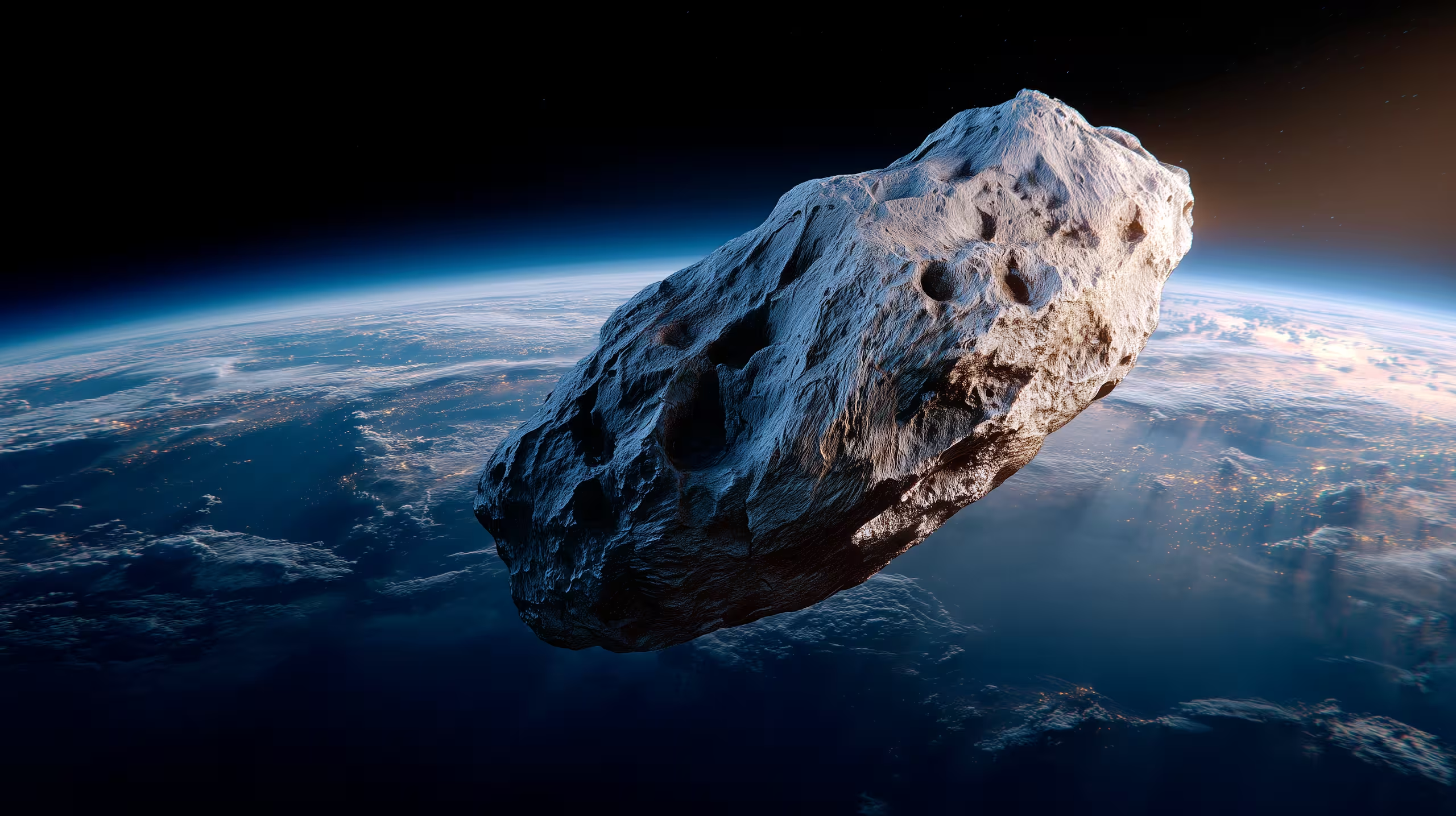
NASA officials confirmed Tuesday that a previously designated “potentially hazardous object” has been formally reclassified as “something we’ll deal with later,” following a routine internal review that concluded the asteroid’s continued approach toward Earth does not currently justify heightened concern.
The object, first identified several months ago during standard near-Earth surveillance, had initially been flagged due to its size, trajectory, and statistical likelihood of passing close enough to merit attention. After further analysis, however, agency officials determined that while the asteroid remains real, measurable, and technically on course, it does not presently require any specific action, response, or meaningful change in posture.
“This isn’t about ignoring the object,” said Dr. Martin Keller, deputy director of planetary risk assessment. “It’s about contextualizing it within a broader framework of future accountability.”
Keller stressed that the asteroid’s reclassification does not indicate new data, altered physics, or reduced impact potential. Rather, he explained, it reflects a shift in how the agency defines urgency.
“At some point,” Keller said, “everything becomes a later problem.”
From ‘Potentially Hazardous’ to ‘Procedurally Deferred’
According to internal documents reviewed by staff, the asteroid’s downgrade followed a multi-week review process that examined not only orbital mechanics, but also public tolerance thresholds, media response patterns, and how far into the future concern remains operationally useful.
“We realized we were reacting to a label more than a situation,” said one senior analyst, who spoke on condition of anonymity because they were not authorized to speak about labels.
The original designation — “potentially hazardous object” — had triggered internal checklists, interdepartmental emails, and at least one calendar invite labeled Asteroid Alignment Sync. Over time, however, officials noted that none of those activities resulted in any actionable conclusions.
“We met. We discussed. We acknowledged the object repeatedly,” the analyst said. “And eventually we asked ourselves what exactly we were doing differently than before.”
The answer, according to meeting notes, was “nothing measurable.”
The Science of ‘Later’
NASA scientists emphasized that the downgrade does not reflect scientific complacency, but rather a nuanced understanding of probability.
“Yes, the asteroid could impact Earth,” said Dr. Elaine Foster, lead orbital dynamics researcher. “But it also could not. And historically, ‘could not’ has been extremely dependable.”
Foster explained that near-Earth objects exist on a spectrum ranging from “theoretically interesting” to “actively inconvenient.” The asteroid in question, she said, remains firmly in the former category.
“It’s big enough to talk about, small enough to postpone,” she said. “That’s a very common category.”
When asked whether postponement increases risk, Foster paused.
“Risk doesn’t increase if you don’t emotionally engage with it,” she said.
Managing Public Anxiety as a Finite Resource
Officials acknowledged that part of the decision involved managing public attention.
“There’s only so much concern the public can sustain at one time,” said NASA spokesperson Daniel Ruiz. “We have to be responsible with how we allocate existential dread.”
Ruiz noted that Americans are currently navigating inflation, healthcare costs, political instability, and “whatever the sun is doing this year.”
“Adding a space rock to that list felt unnecessary,” he said.
NASA communications staff reportedly tested several hypothetical headlines internally before settling on silence.
“Anything involving the word ‘asteroid’ tends to spike cortisol,” one staffer said. “We’re trying to lower cortisol.”
Internal Confidence Remains Steady
Within the agency, morale reportedly improved following the downgrade.
“Once we stopped calling it hazardous, people relaxed,” said an engineer assigned to trajectory modeling. “Hazardous implies follow-up.”
Another employee said the change reduced inbox traffic by nearly 40 percent.
“We were getting emails like, ‘Just checking if the asteroid is still coming,’” they said. “Now no one’s checking.”
Officials emphasized that the object remains under observation through existing monitoring systems, provided those systems remain operational and relevant.
“We’re still watching it,” Keller said. “We’re just watching it in the same way you watch something you’re not emotionally prepared to deal with.”
Think Tanks Applaud the Restraint
Several policy institutes quickly weighed in, treating the decision as a model of modern governance.
“This reflects a mature approach to uncertainty,” said a senior fellow at the Meridian Institute for Strategic Foresight. “Acknowledging a problem without committing to solving it preserves institutional flexibility.”
A white paper from the Center for Long-Term Considerations described the downgrade as “responsibly noncommittal.”
“The asteroid exists,” the paper noted. “But so does tomorrow.”
Another think tank praised NASA for resisting what it called “solution urgency.”
“Not every problem benefits from action,” the report concluded. “Some benefit from patience, reframing, and a well-timed future press release.”
Legal and Policy Ambiguity
Legal scholars acknowledged that there is no clear precedent for when an asteroid becomes actionable.
“There’s no statute that says, ‘At X percent chance of impact, you must do Y,’” said constitutional law professor Henry Walsh. “Which gives agencies tremendous interpretive freedom.”
Walsh added that the absence of precedent is itself stabilizing.
“If you can’t be wrong yet, you’re not wrong,” he said.
Asked whether delaying action could create liability, Walsh shrugged.
“Liability requires outcomes,” he said. “We’re very far from outcomes.”
Public Guidance Remains Simple
When asked what, if anything, Americans should do in response to the asteroid, Ruiz was clear.
“Nothing,” he said. “Continue your routines.”
Ruiz later clarified that this guidance applies regardless of future developments, unless otherwise stated.
“If that changes,” he said, “we’ll absolutely tell people.”
He paused, then added, “With adequate notice.”
Looking Ahead, Conceptually
No timeline has been set for reevaluating the asteroid’s status. Officials said future assessments are inevitable, though not scheduled.
“We’ll revisit it when it feels relevant,” Keller said. “Or when something else forces the issue.”
Until then, NASA maintains that the situation remains stable, monitored, and comfortably abstract.
“Space is very large,” Foster said. “That works in our favor most of the time.”
As the briefing concluded, Ruiz offered a final reassurance.
“If this becomes something we need to deal with,” he said, “we’ll deal with it.”
He then added, after a brief pause, “Later.”
