
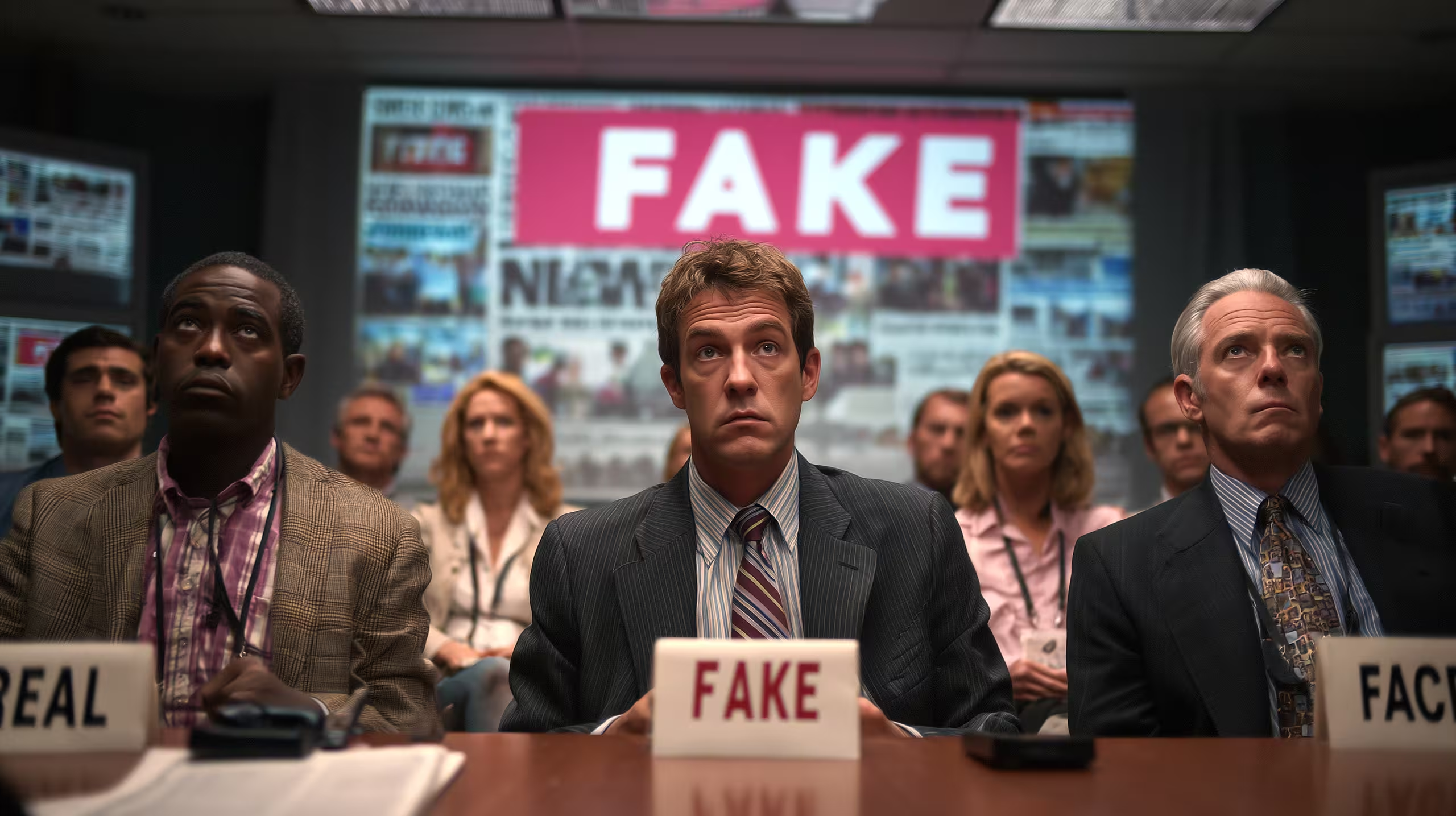
New Study Finds 73% of Americans Now Unsure If Any News Is Real Anymore
A new nationwide study released Tuesday has confirmed what many Americans have quietly suspected for several years: roughly 73% of the population is no longer confident that any piece of news they encounter is actually real.
The report, conducted by the Center for Public Information Studies, surveyed more than 4,000 adults across the United States and asked participants to evaluate a series of headlines drawn from real news sources, satirical websites, and several items researchers openly admitted they had “completely made up five minutes earlier.”
The results were, according to the researchers themselves, “deeply concerning but also extremely funny.”
“Participants frequently stared at headlines for several minutes before answering,” said Dr. Melissa Harding, the study’s lead author. “In many cases they simply sighed and said something like, ‘I mean… yeah, that sounds fake. But also I wouldn’t be surprised.’”
Harding explained that the goal of the study was to measure how confidently Americans could distinguish between legitimate journalism and satirical or fabricated headlines.
Instead, researchers discovered that many participants had reached what the report describes as a “baseline state of permanent skepticism.”
“Several participants appeared to assume everything was fake,” Harding said. “Others assumed everything was real. And a surprising number simply asked if they could skip the question because the entire internet has become emotionally exhausting.”
Focus Groups Descend Into Existential Debate
In several recorded focus groups, the experiment quickly spiraled into philosophical territory as participants attempted to determine whether specific headlines were authentic.
One example headline read:
- “Congress Accidentally Funds Study on Whether Congress Should Exist.”
Participants debated the headline for nearly seven minutes.
“At first I thought it was satire,” said one participant from Ohio. “But then again, that’s the exact kind of thing Congress would accidentally do.”
Another participant insisted the headline must be fake, only to immediately reverse his opinion.
“Actually wait,” he said after a long pause. “No… that feels real. I hate that it feels real.”
According to the study’s transcripts, the most common response among participants was a prolonged silence followed by the phrase:
- “Honestly, I have no idea anymore.”
In another focus group, participants were shown the headline:
- “Town Council Meeting Lasts Nine Hours, Produces No Decisions But Several Strong Feelings.”
The group immediately agreed the headline was real.
Researchers later confirmed that it had been completely fabricated.
“That one fooled everyone,” Harding said. “But only because it sounded extremely realistic.”
Researchers Attempt to Maintain Scientific Objectivity
The research team initially believed the experiment would reveal clear patterns in how Americans evaluate news credibility.
Instead, the study quickly revealed that many participants no longer trust any headline that appears on a screen.
During one portion of the test, participants were shown three headlines:
- “Scientists Discover New Planet That Smells Like Burnt Toast”
- “State Government Accidentally Buys 600,000 Office Chairs”
- “Mayor Declares War on Aggressive Squirrels”
Participants struggled to classify all three.
One respondent insisted the squirrel war headline was satire.
Another responded confidently that it was real.
A third participant simply asked if the mayor had already won the war.
In another test, participants were shown the headline:
- “Man Accidentally Joins Neighborhood HOA Board After Clicking Wrong Link.”
The focus group unanimously declared it satire.
Researchers later revealed that the headline had been taken from an actual local news story.
“The room went completely silent,” Harding said. “One participant whispered, ‘That’s terrifying.’”
Internet Has Permanently Altered News Perception
Experts say the confusion stems from years of increasingly bizarre real-world news stories combined with the rapid spread of satire, misinformation, and social media commentary.
“In previous decades, satire was easy to identify because it was obviously absurd,” explained media analyst Jordan Feldman. “But now reality frequently surpasses satire.”
Feldman noted that modern headlines often contain phrases that would have sounded ridiculous just ten years ago.
“When people see something like ‘Government Investigates Giant Balloon,’ they genuinely have to stop and think,” Feldman said.
“In 2010 that would have been obvious satire. Today it could easily be a Tuesday.”
The study also found that many Americans now approach news with what researchers describe as “defensive disbelief.”
“Participants often assume the headline must be fake first,” Harding explained. “Then they slowly come to terms with the possibility that it might actually be real.”
Several respondents reported that they now rely on a personal rule of thumb when evaluating news:
- If it sounds ridiculous, it might be real.
- If it sounds extremely ridiculous, it might be politics.
- If it sounds unbelievably ridiculous, it might still somehow be real.
Participants Begin Questioning The Study Itself
Perhaps the most unexpected development occurred near the end of the research sessions when several participants began questioning whether the study itself was real.
At one point a participant raised his hand and asked researchers directly:
- “Is this entire experiment satire?”
Another participant immediately agreed.
“I feel like this might be fake news designed to test how gullible we are,” she said.
A third participant proposed that the entire focus group might actually be part of a hidden-camera prank show.
“Are we on TV right now?” he asked nervously while looking around the room.
Researchers assured participants that the study was legitimate.
However, according to the final report, several participants remained unconvinced.
One respondent wrote in the survey’s final comment section:
- “I still think this whole thing might be a prank.”
Another simply wrote:
- “If this turns out to be satire, I won’t even be surprised.”
Researchers Admit They Are Now Also Confused
Following weeks of reviewing focus group footage, several members of the research team admitted the experiment had begun affecting their own perception of reality.
“We started second-guessing headlines ourselves,” said Dr. Harding.
“At one point I read a story about a city banning leaf blowers and immediately thought it must be satire.”
After a brief pause, Harding added:
“It wasn’t.”
Another researcher reported experiencing what the study refers to as “headline fatigue,” a condition where readers become so accustomed to bizarre news that nothing feels implausible anymore.
“At some point you just shrug and keep scrolling,” Harding said.
The study concludes that while Americans may still consume large amounts of news every day, their confidence in the reality of what they are reading has dropped to what researchers describe as “historically surreal levels.”
The final recommendation from the research team was simple:
“If a headline sounds completely ridiculous,” the report states, “it is now approximately 50% likely to be real.”
The remaining 50 percent, researchers clarified, is likely satire, misinformation, or “something that will be real within six months.”
