
Biologists Alarmed as Urban Raccoons Begin Making Eye Contact
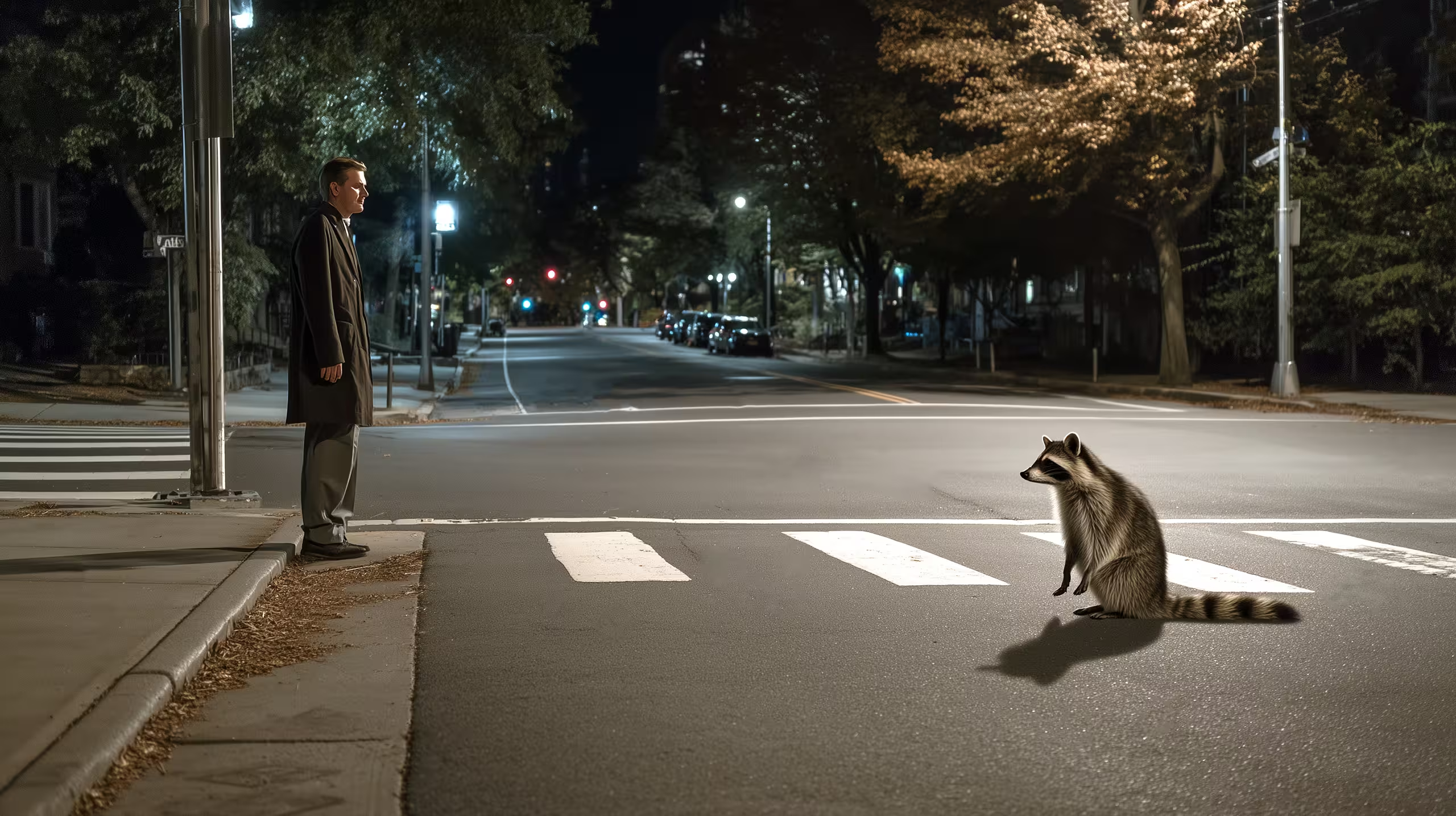
Biologists across multiple urban research institutions are expressing concern following a growing number of reports that raccoons living in major metropolitan areas have begun making sustained, deliberate eye contact with humans.
Researchers Say the Behavior Represents a “Shift in Awareness,” Not Just Curiosity
The behavior, first noted anecdotally by residents in Chicago, Philadelphia, and parts of the greater New York City area, has since been documented in formal observational studies and described by experts as “unusual,” “deeply uncomfortable,” and “likely indicative of some form of cognitive recalibration.”
“This is not the quick glance you expect from a startled animal,” said Dr. Eleanor Whitcombe, a behavioral ecologist at the Mid-Atlantic Institute for Urban Wildlife. “This is a steady, evaluative look. They’re not checking for threats. They’re checking you.”
According to Whitcombe, raccoons have always been observant animals, but the duration and intention behind this new behavior marks a noticeable departure from previously documented interactions.
“They’re holding the gaze,” she said. “That’s the part we don’t like.”
Eye Contact Lasting Longer Than Necessary
In controlled field observations conducted over the past six months, researchers recorded raccoons maintaining eye contact with human subjects for periods ranging from three to eight seconds. In several cases, the animals remained completely still during the interaction.
“Eight seconds is a very long time in animal behavior,” explained Dr. Marcus Levin, a comparative cognition specialist. “In social species, eye contact can indicate dominance, curiosity, bonding, or threat. Raccoons are not traditionally social in this way.”
Levin noted that most urban wildlife exhibits avoidance behaviors when encountered by humans. Even animals accustomed to city environments typically avert their gaze or retreat when noticed.
“These raccoons aren’t retreating,” he said. “They’re waiting.”
Residents who have experienced the phenomenon describe it as unsettling rather than aggressive.
“It didn’t hiss or run,” said Brooklyn resident Angela Morales. “It just sat there on the trash can lid and stared at me like it was waiting for me to explain myself.”
Morales said the raccoon did not blink during the encounter.
Urban Adaptation or Something Else
Experts stress that raccoons are among the most adaptable mammals in North America, thriving in cities by exploiting human infrastructure, food systems, and behavioral predictability.
“They understand our schedules better than we do,” said Whitcombe. “Trash nights. Commuting patterns. When people are distracted.”
Some researchers believe the eye contact may be a byproduct of increased exposure to humans, combined with generations of successful coexistence.
“At some point, fear gives way to assessment,” said Levin. “They’re no longer asking, ‘Is this dangerous?’ They’re asking, ‘What is this doing here?’”
Others are less convinced that the shift can be explained through adaptation alone.
“This feels different,” said one wildlife researcher who requested anonymity. “We’ve studied raccoons for decades. This isn’t just comfort. This is awareness.”
Researchers Warn Against Interpreting Intent
Despite the growing unease, scientists caution against assigning human motives to the animals.
“They’re not plotting,” said Whitcombe. “They’re not judging. They’re not forming opinions.”
She paused.
“That said, we don’t actually know what they’re doing.”
Behavioral experts emphasize that prolonged eye contact in humans carries heavy social meaning, but that meaning does not always translate across species.
“It may simply be a learned behavior,” said Levin. “They’ve realized that humans freeze when stared at.”
Field footage supports this theory. In several recorded encounters, human subjects visibly hesitate, unsure whether to move, speak, or retreat.
“In that moment,” Levin said, “the raccoon controls the interaction.”
Municipal Agencies Quietly Take Notice
While city officials have largely avoided public comment, internal communications obtained by staffers suggest growing concern.
One Parks Department memo described the behavior as “not currently actionable but worth monitoring.”
Another advised staff to “avoid prolonged eye contact with urban wildlife when possible,” without offering further explanation.
“They don’t want to alarm people,” said a city employee familiar with the discussions. “But they also don’t want to explain why raccoons are suddenly staring back.”
Public Reaction Ranges From Humor to Unease
Online, reactions have ranged from jokes to genuine concern.
“My raccoon made eye contact and now I feel like I owe him rent,” one post read.
Another user wrote, “If they start nodding, I’m moving.”
Some residents have attempted to test the behavior deliberately, standing still to see whether the raccoon will break eye contact first.
“They usually don’t,” said Morales. “I do.”
Experts Note a Pattern of Escalation
Several biologists point out that eye contact may represent only the most visible stage of a longer behavioral progression.
“First they stopped running,” said Levin. “Then they started approaching. Now they’re engaging.”
He described this as a classic pattern in adaptive intelligence.
“Animals push boundaries incrementally,” he said. “They test. They observe. They adjust.”
When asked what the next stage might look like, Levin declined to speculate.
“There’s no reason to assume escalation,” he said. “But there’s also no reason to assume this is the end of it.”
What Residents Are Being Advised to Do
At present, wildlife officials recommend maintaining distance and avoiding direct engagement.
“Do not stare back,” advised one state wildlife agency spokesperson. “And do not attempt to interpret the behavior.”
Residents are also encouraged to secure trash bins, avoid feeding wildlife, and resist the urge to “see what happens if you hold eye contact longer.”
“Nothing good comes from a staring contest with a raccoon,” Whitcombe said.
The Question Nobody Is Answering
Despite reassurances, one question remains conspicuously unanswered.
Why now?
Urban raccoons have lived alongside humans for generations. Yet the behavior appears to have emerged rapidly and nearly simultaneously across multiple cities.
Some researchers point to environmental stressors. Others cite changes in urban lighting, surveillance cameras, or increased human distraction.
“We are more observable than ever,” said Levin. “Phones. Screens. Headphones. We don’t look around anymore.”
He paused.
“They do.”
A Development Being Taken Seriously, Despite the Tone
While the phenomenon has inspired humor, experts insist the research is legitimate.
“This is how adaptation looks in real time,” Whitcombe said. “It’s not dramatic. It’s subtle. It’s unsettling because it’s quiet.”
She emphasized that no aggressive incidents have been linked to the behavior.
“They’re not attacking,” she said. “They’re observing.”
Asked whether she finds the behavior personally disturbing, Whitcombe sighed.
“I wouldn’t say disturbing,” she said. “I’d say… clarifying.”
For Now, the Raccoons Continue Watching
As research continues, biologists stress that there is no immediate cause for alarm.
“Cities are dynamic ecosystems,” Levin said. “We share them with other intelligences.”
Still, many residents report feeling a subtle shift.
“It’s not that they’re scary,” Morales said. “It’s that they look like they know where they are.”
And, increasingly, who they’re looking at.
For now, the raccoons remain calm, silent, and attentive — perched on trash bins, fire escapes, and sidewalks — watching as humans pass by.
Watching back.
